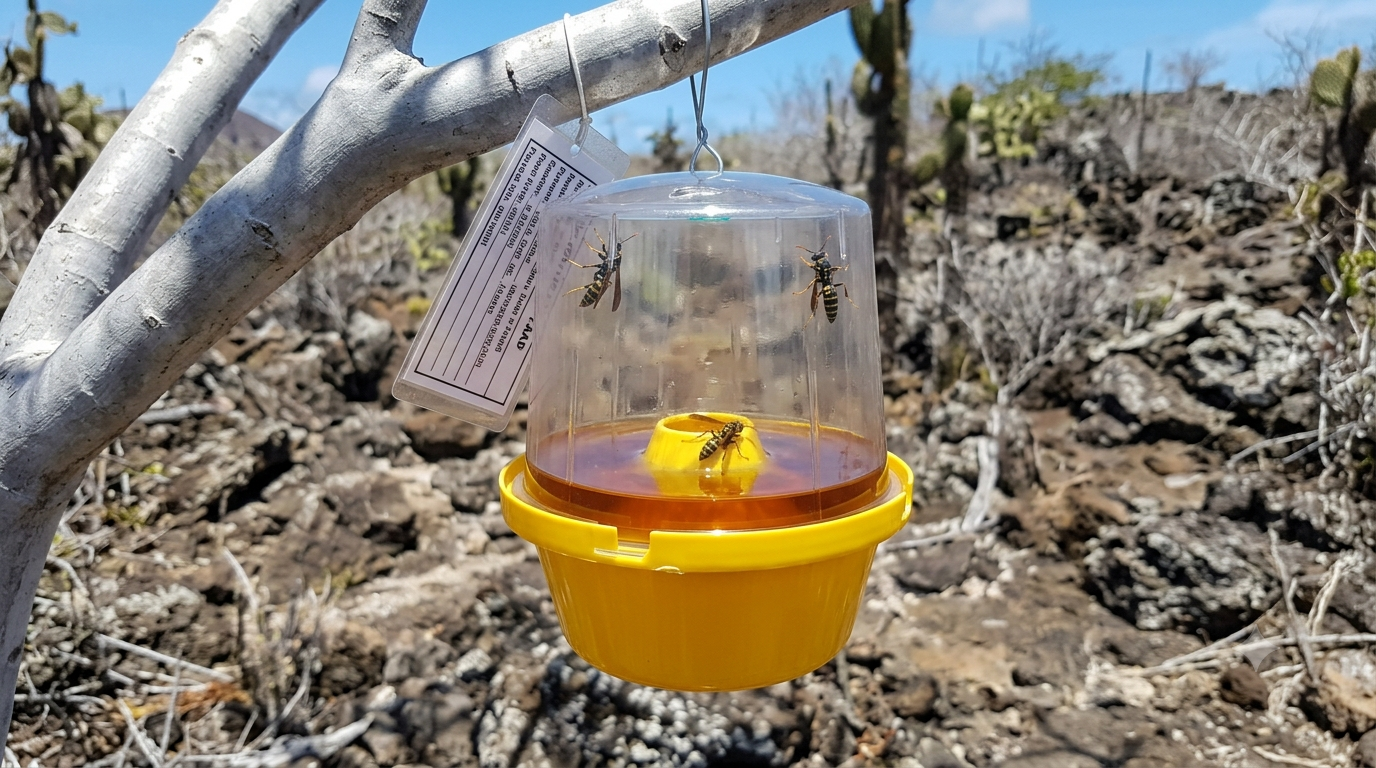
Invasive since 1988
Yellow paper wasp
Most visitors leave the Galápagos without ever seeing this problem. Polistes versicolor arrived in the 1980s and has since displaced native Galápagos carpenter bees from their nesting sites across the archipelago. It builds paper nests on any surface, in any habitat — adaptable, aggressive, with no natural population control here.
The vine itself may not be immediately visible to visitors, but its impact is. These invasions spread aggressively, alter ecosystems, and threaten the species that depend on those habitats. What you hold is a record of that problem — and proof that Galapagueños are doing something about it.
Collection record
| Species | Polistes versicolor (de Saussure, 1853) |
| Collection site | Private agricultural land, Santa Cruz Island, Galápagos |
| GPS coordinates | 0.6887°S, 90.3106°W |
| Collection date | — |
| Method | Attractant trap — private agricultural land |
| Land status | Private agricultural land · No park permit required |
| Craftsperson | E.C. · Santa Cruz Island |
Your purchase funded this removal.
All profits reinvested in Galápagos.
Conservation of Galápagos, by Galapagueños.
The maker
[Name]
Craftsperson · Santa Cruz Island
"My family has been on this island for three generations. What happens here is my business."
Why this matters
The Galápagos ecological crisis is not a photogenic crisis. The invasive wasp occupying native nesting sites doesn't appear in documentaries. These are slow, structural emergencies — deeply familiar to anyone who lives here, largely invisible to the hundreds of thousands of visitors who pass through each year.
Every time you show this piece and explain its story, awareness reaches somewhere it didn't before. Every purchase funds the removal of more.
Be the first to know when the next piece is made.
No spam. Unsubscribe any time.